CONCEPT Cited by 3 sources
LTX file format (LiteFS Transactions)
Definition
LTX — LiteFS Transactions — is the on-wire / on-disk file format Fly.io's LiteFS uses to represent sorted, per-transaction changesets of SQLite pages. Each LTX file is a sorted run of page-range records scoped to the time window its transactions cover. Reference implementation: superfly/ltx.
Because LTX files are sorted by page number and carry explicit transaction boundaries, they behave like an LSM-style sorted run over SQLite pages:
- Multiple LTX files can be merged (k-way-merged by page number), producing a single LTX file that keeps only the latest version of each page over the combined time range.
- Merging adjacent time windows is compaction; the resulting file is the point-in-time state of the database at the end of the window, represented as sorted pages.
- A database can be reconstructed at any time
twithin retention by taking all LTX files whose window ends at or beforetand compacting them.
From the 2025-05-20 Litestream redesign post:
"Each LTX file represents a sorted changeset of pages for a given period of time. Because they are sorted, we can easily merge multiple LTX files together and create a new LTX file with only the latest version of each page. … This is similar to how an LSM tree works." (Source: sources/2025-05-20-flyio-litestream-revamped)
Why this matters vs raw WAL shipping
The original Litestream design shipped raw WAL pages — every physical change to every page, regardless of whether the page was rewritten a thousand times in the retention window. Restore cost scaled with WAL volume, not with distinct logical pages touched. Restoring a database where one page was rewritten 1,000 times meant replaying 1,000 page-write records.
LTX changes the shape twice:
- Transaction-aware, not frame-aware. Each file is scoped to transactions (not WAL frames), so the unit of replay is a coherent commit, not a raw WAL fragment.
- Sortable and merge-compactable. Because LTX files are
sorted, two LTX files covering consecutive windows
k-way-merge into one file retaining only the latest version
of each page — so restore to time
tcosts the size of the compacted state att, not the cumulative WAL volume since the last snapshot.
That's why Ben Johnson calls out "minimal duplicate pages" as the key property post-compaction: in the compacted LTX, each page appears at most once.
Structural role in the LiteFS/Litestream stack
Before the 2025-05-20 Litestream redesign, LTX was LiteFS-only — LiteFS shipped LTX between primary and replica nodes over the network, while Litestream shipped raw WAL frames to object storage. The redesign converges the two tools on LTX:
- LiteFS uses LTX for node-to-node replication (primary → replica).
- Litestream (post-redesign) uses LTX for node-to-object-store replication (primary → S3 / Tigris).
This unification is the load-bearing design move behind the rest of the redesign: with LTX as the shared format, compaction, fast PITR, VFS-based read replicas, and wildcard-directory replication all follow.
Comparison vs SQLite WAL
| Property | SQLite WAL frame | LTX file |
|---|---|---|
| Unit | raw page write | page-range in a committed transaction |
| Ordering | append order | sorted by page number |
| Merge-compactable | no (would require sort) | yes |
Restore cost to time t |
proportional to frame count since snapshot | proportional to compacted state at t |
| Multi-database support | one WAL per DB | one LTX stream per DB; sortable fleet-wide |
| Transaction awareness | per-frame, boundary implicit | explicit per-transaction |
Visual
From the post:
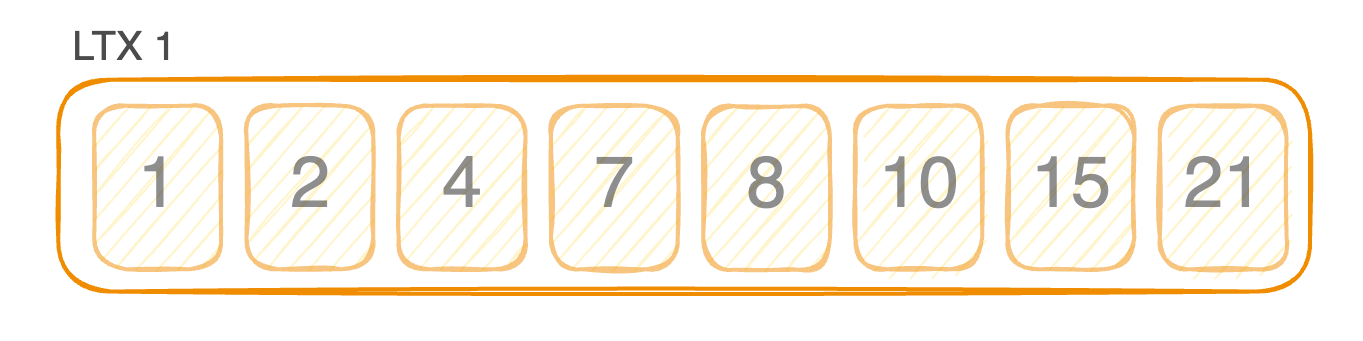
"A simple linear LTX file with 8 pages between 1 and 21."
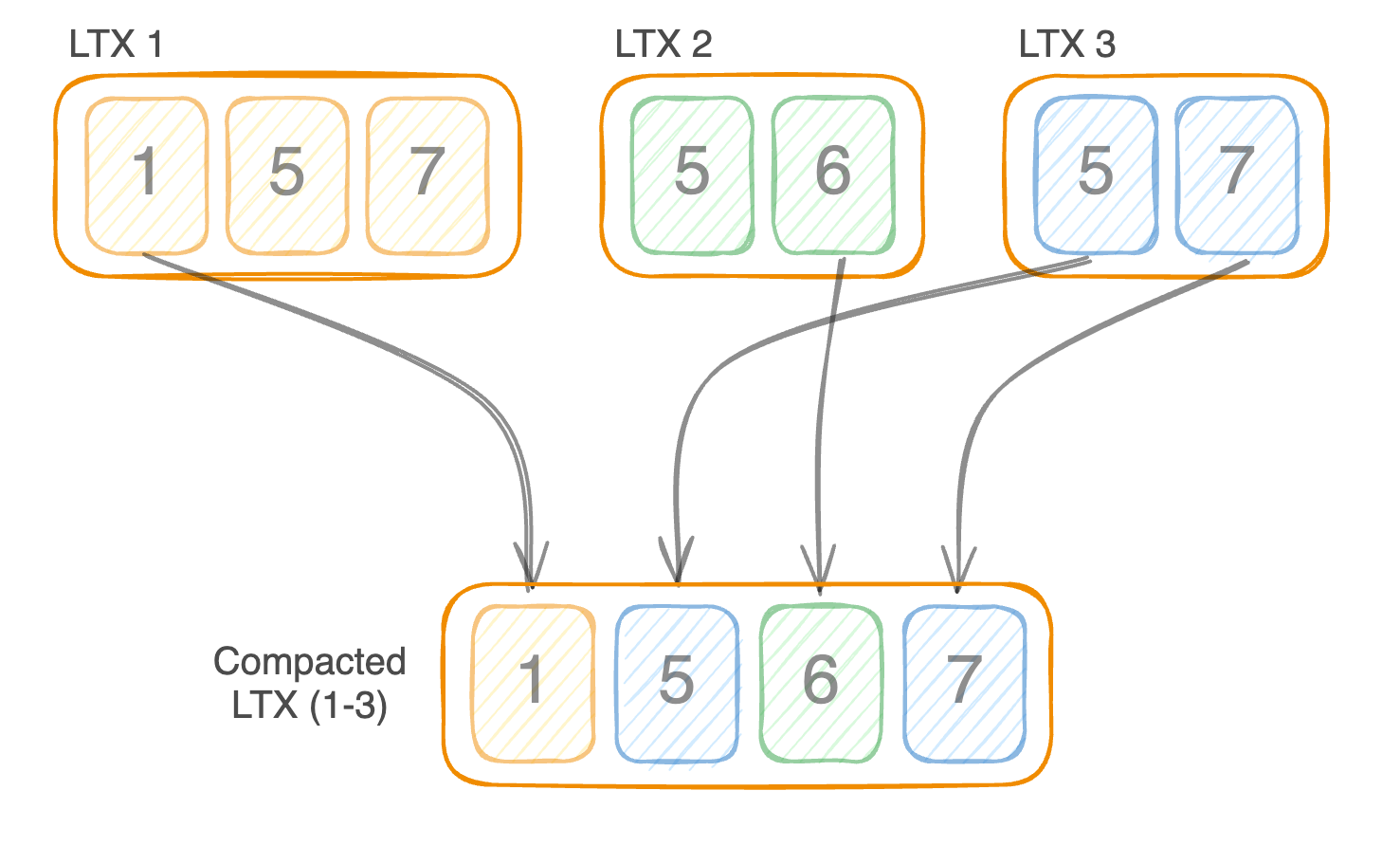
"Merging three LTX files into one."
2025-10-02 shipping disclosure: per-page compression + EOF index
The 2025-10-02 Litestream v0.5.0 shipping post (sources/2025-10-02-flyio-litestream-v050-is-here) adds two concrete implementation-level properties to the LTX format:
"It used to be an LTX file was just a sorted list of pages, all compressed together. Now we compress per-page, and keep an index at the end of the LTX file to pluck individual pages out. You're not seeing it yet, but we're excited about this change: we can operate page-granularly even dealing with large LTX files. This allows for more features. A good example: we can build features that query from any point in time, without downloading the whole database."
Two things changed:
- Whole-file compression → per-page compression. Pages are now individually compressed frames rather than a single compressed sorted run. Compression efficiency per byte drops slightly (compressor context smaller) but random access becomes cheap.
- End-of-file index. Each LTX file has an index at its tail mapping page-number → byte-offset, so a reader can HTTP range-GET a specific page without downloading the whole file.
Why this matters: this is the structural precondition for the VFS-based read-replica layer still on Litestream's roadmap. A read-replica needs to fetch just the pages a query touches, not the whole database, out of remote storage — which requires random-accessible pages inside LTX files.
Monotonic TXID as the addressing primitive
The 2025-10-02 post also names monotonic transaction IDs (TXIDs) as the LTX addressing primitive that retired Litestream's "generations":
"we have a monotonically incrementing transaction ID. We can use it to look up database state at any point in time, without searching across generations."
TXID is the addressing scheme LTX files use; the user-visible
CLI now carries TXIDs where the pre-revamp generation/index/offset
tuple used to appear (litestream wal → litestream ltx).
2025-12-11 disclosure: trailer size ~1% of LTX file
The 2025-12-11 Litestream VFS ship announcement quantifies the EOF index trailer for the first time:
"LTX trailers include a small index tracking the offset of each page in the file. By fetching only these index trailers from the LTX files we're working with (each occupies about 1% of its LTX file), we can build a lookup table of every page in the database." (Source: sources/2025-12-11-flyio-litestream-vfs)
The ~1%-of-file datum is the load-bearing economic property for the VFS: a cold-opening reader can build a full database-wide page-lookup table by range-reading just the last 1% of each relevant LTX file — orders of magnitude cheaper than downloading the files in full, and cheap enough to be the default startup path.
See concepts/ltx-index-trailer for the standalone concept page on the trailer itself.
Seen in
- sources/2025-05-20-flyio-litestream-revamped — canonical wiki disclosure; LTX framed as the shared file format that post-revamp unifies LiteFS + Litestream. Merge-and-compact visualization included.
- sources/2025-10-02-flyio-litestream-v050-is-here —
shipping-level disclosure. LTX library now compresses
per-page (not whole-file) with an end-of-file index
making individual pages random-accessible via HTTP range-GET
— the structural precondition for VFS-based read replicas.
Also confirms monotonic TXID as the addressing primitive
replacing
generation/index/offset(CLI:litestream wal→litestream ltx). - sources/2025-12-11-flyio-litestream-vfs — trailer-size disclosure + first production consumer. EOF index trailer occupies ~1% of each LTX file; reading the trailers for all LTX files in the retention window is the cold-open path that lets Litestream VFS serve queries without downloading the database. Confirms per-page compression + EOF index as shipped capabilities being put to load-bearing use.
Related
- systems/litefs — the original LTX consumer (node-to-node).
- systems/litestream — post-revamp LTX consumer (node-to-object-store).
- systems/litestream-vfs — reads LTX trailers + pages via HTTP Range GET to serve SQLite reads.
- systems/sqlite — the substrate whose pages LTX encodes.
- systems/aws-s3 — the
Range-GET primitive used against LTX files. - concepts/ltx-index-trailer — the tail index section enabling random page access.
- concepts/sqlite-vfs — the integration surface consuming the random-access primitive.
- concepts/lsm-compaction — the algorithm LTX compaction is patterned on.
- concepts/wal-write-ahead-logging — the lower-level primitive LTX replaces as a replication source.
- concepts/shadow-wal — the legacy Litestream mechanism LTX makes obsolete.
- patterns/ltx-compaction — the pattern instantiated on LTX.
- patterns/vfs-range-get-from-object-store — the read-side pattern that composes LTX + VFS + object-store Range GETs.
- patterns/sqlite-plus-litefs-plus-litestream — the three-layer stack LTX now unifies.